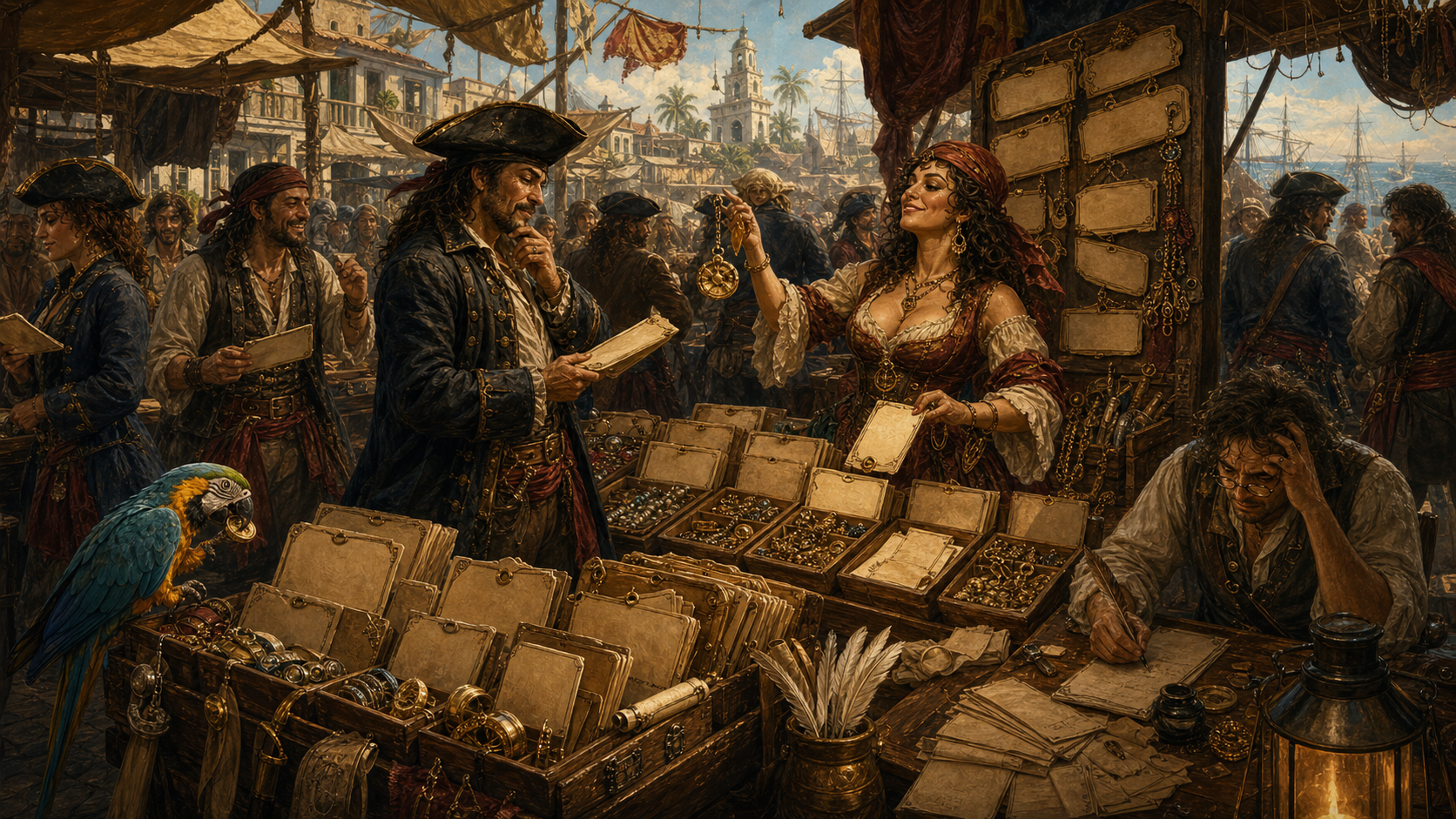
A pirate lexicon must feel useful, not like a costume trunk exploded across the deck.
The best salty words are clear, lively, and honest about what they are. Some come from broad sailor language. Some belong to later pirate fiction and performance. Some are modern party shorthand. All of them can be fun if the story keeps the distinction visible.
This is not a sacred dictionary of how every pirate truly spoke.
It is a working vocabulary for readers, writers, teachers, party planners, and anyone who wants pirate flavor without forcing history into a plastic hook.
Use the words that carry meaning. Leave the rest in the prop chest until the scene actually calls for them.
A single precise word can make a sentence feel seaworthy.
A paragraph stuffed with “avast,” “matey,” and “ye” can make even a patient reader look for a lifeboat.
How to use pirate words without sounding fake
Begin with the situation.
A sailor giving an order requires different language from a captain bluffing a merchant vessel, a narrator making a joke, or a teacher trying to keep a classroom from mutiny. Shipboard words work best when they describe real things: deck, mast, sail, hold, helm, watch, broadside, prize, powder, quartermaster, galley, anchor, reef, and line.
They remind the reader that piracy happened in a physical world of wood, canvas, hunger, weather, law, and fear.
Accent words need more caution.
“Arrr” and “matey” are recognizable, but recognition is not the same as evidence. They belong mostly to performance tradition and modern pirate play. That does not ban them. It just means they is best used with a wink, not sold as universal historical speech.
A useful pirate lexicon has labels.
Nautical term.
Performance phrase.
Modern party word.
Possible historical usage, but use carefully.
That kind of honesty keeps the fun from pretending to be a court record.
Hails and commands
Ahoy is a hail, a way to get attention. It is broadly nautical rather than exclusively pirate, which makes it useful and safer than many theatrical phrases. Use it when a speaker is calling across space: to another ship, a person on deck, or a reader entering the joke.
Avast means stop, hold, or pay attention. It carries a strong command shape, which is why it survives so well in pirate performance. In writing, it is strongest when the halt matters: “Avast there. That fuse is shorter than your confidence.”
Aye means yes, agreement, or acknowledgment. It is useful because it is short and clear. A sailor can answer an order with it without sounding like a cartoon.
Aye aye signals that an order is understood and will be carried out. It is more naval than pirate-specific, but it works in shipboard-flavored writing when used with restraint.
Belay means stop, cancel, or secure, depending on context. “Belay that order” has a cleaner bite than a paragraph full of theatrical growling.
The lesson: commands work because they do things. If a word does not change the action, consider throwing it overboard.
Shipboard words that earn their keep
Deck is the working floor of the ship. It gives a scene immediate physical location.
Mast holds the sails and gives the eye something vertical to fear during a storm.
Line is often better than “rope” in shipboard language, though not every rope aboard becomes a line in every context. Use it when it helps the sentence feel like ship work.
Helm points to steering and control. “Take the helm” carries authority without needing decoration.
Hold is where cargo may be stored. It is useful in pirate stories because cargo is often the reason everyone is behaving badly.
Watch is both duty and vigilance. “Keep watch” is stronger than “look around in a piratical fashion.”
Broadside is the firing of guns from one side of a ship. It is dramatic, but cannot be used for every argument unless the argument has cannons.
Prize is a captured vessel or goods taken in maritime conflict. It is one of the most useful pirate-history words because it connects violence, profit, and law.
These words help because they belong to the world. They are not decoration. They are furniture with splinters.
People aboard
Captain is obvious, but pirate captains were not always absolute tyrants. On some ships, crews could elect or remove leaders, especially outside battle. Use the word with awareness of the crew behind it.
Quartermaster is one of the most important pirate terms. In many pirate crews, the quartermaster had major authority over shares, discipline, and the crew’s interests. If a page wants to show pirate organization rather than costume chaos, this word is gold.
Boatswain or bosun refers to an officer responsible for ship equipment, rigging, and practical work. Useful when the scene requires maritime competence.
Gunner handles the guns. Simple, useful, physical.
Carpenter matters more than people expect. A ship is a wooden machine constantly trying to become debris.
Surgeon or doctor may appear where injury, disease, and shipboard survival matter. Pirate crews were bodies under stress before they were hats and knives.
A good lexicon remembers that ships were workplaces. The captain gets the familiar image. The crew keeps the vessel alive.
Words with theatrical warning labels
Arrr is the grand beast of pirate performance. It is not useless. It is just not the key to the historical archive. Use it for comedy, performance, or obvious pirate play.
Matey is friendly, comic, and instantly recognizable. Use it when the tone is playful. Avoid it in serious historical passages unless the case is explaining performance speech.
Scallywag is fun, but more useful as playful insult than hard history.
Shiver me timbers belongs strongly to pirate-flavored entertainment. It is famous because fiction made it famous.
Yo ho ho is a song-shaped phrase lodged in public imagination by literature and popular culture. Use it when the story wants to nod to the fiction tradition.
These words are not forbidden. They simply need the right room. A Halloween page can use them freely.
Better insults than noise
Pirate insults work best when they are specific.
“Coward” is clearer than “scurvy dog” if the scene is serious.
“Bilge rat” is theatrical, but useful when the tone is comic.
“Landlubber” works when the insult is about seamanship or inexperience.
“Dog” appears in older insult traditions and can sound sharper than more decorative options.
The most effective insult often names the failure.
“You steer like a drunk priest.”
“You count shares like a man with borrowed fingers.”
“You would miss land from the beach.”
Those lines are more alive than a pile of prefabricated slang because they create a moment. A lexicon gives ingredients. Good writing still must cook.
What survives
Pirate words are useful when they help the reader see the ship, hear the order, feel the threat, or understand the joke.
They fail when they become costume noise.
The strongest pirate lexicon is not the longest one. It is the clearest one: nautical terms for real shipboard things, performance words for playful pirate sound, and honest labels where later fiction has done more work than history.
Use the slang. Enjoy the salt.
Just do not let “arrr” steer the whole vessel.


