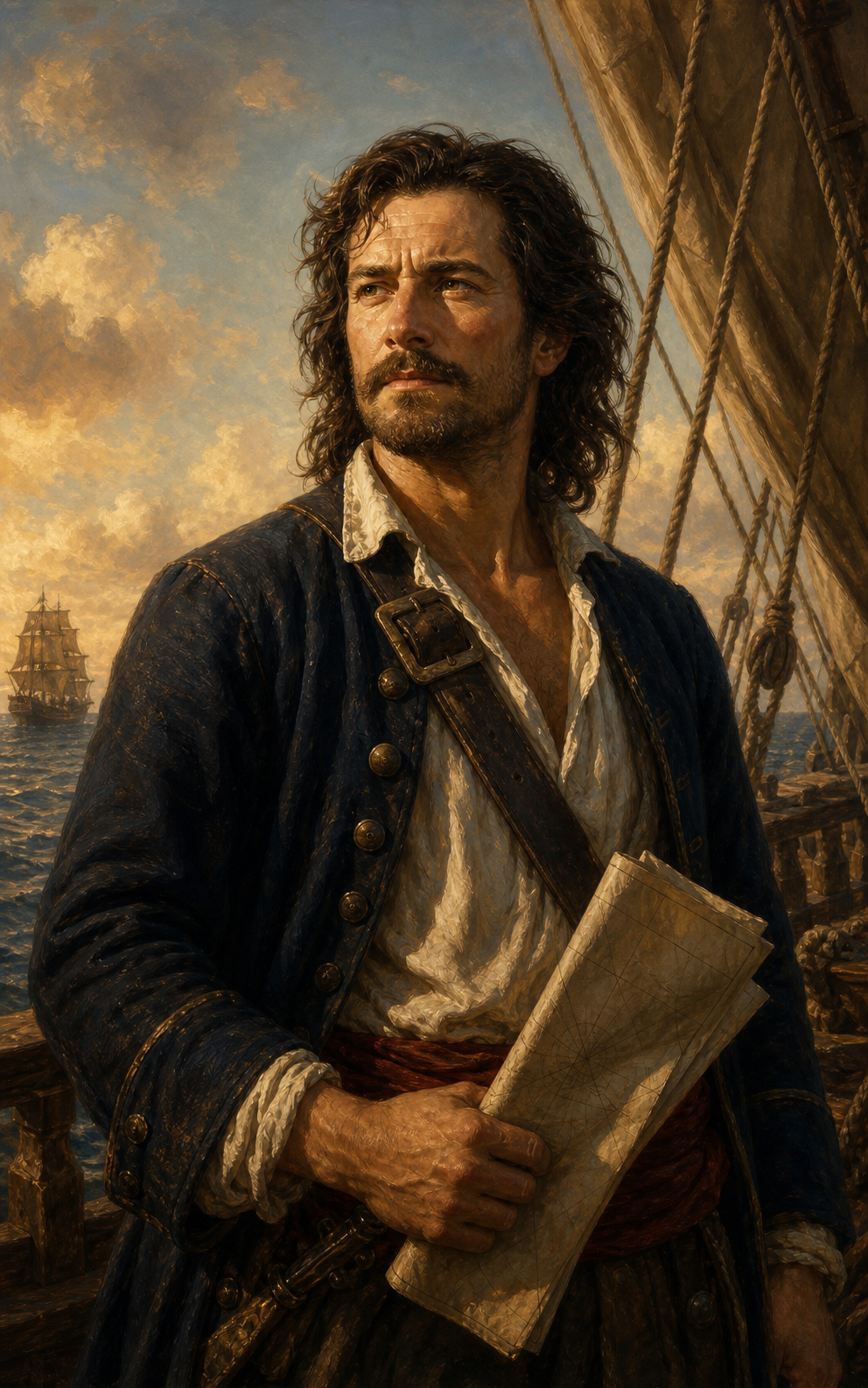
The story
Henry Every Stole a Fortune. Then He Disappeared
Henry Every became famous for two acts that governments hated and storytellers loved: he captured an astonishing prize, and then he disappeared. The disappearance gives the tale its smoke, but the prize is the part that shook governments. In 1695, Every and his crew attacked the Mughal ship Ganj-i-Sawai in the Indian Ocean, a vessel connected to one of the richest and most powerful empires in the world. The raid was more than a spectacular theft. It threatened English trade in India, enraged Mughal authorities, and turned one pirate cruise into a diplomatic emergency.
Every robbed a ship, became rich, and exposed how fragile English commercial privilege could be when pirates struck the wrong target. He helped expose how fragile English commercial privilege could be when a pirate crew attacked the wrong target. English merchants needed permission, trust, and political patience to keep operating in Mughal ports. Every's violence put those relationships under pressure. A pirate could be small beside an empire and still cause imperial trouble if the victim was connected to trade, religion, prestige, and state authority.
The Mutiny That Made Every
Henry Every, also spelled Avery in many accounts, was an English sailor before he became a pirate captain. In 1694 he was aboard the Charles II, a privateering vessel associated with an expedition against French interests. The venture stalled, pay and patience thinned, and the crew mutinied in Spanish waters. They renamed the ship Fancy, a name so mild it almost feels like a joke told by paperwork. Under Every's command, the ship headed away from failed employment and toward piracy.
Every’s career began in labor, frustration, and opportunity rather than in a clean villain origin. Sailors did not need to be saints to resent bad pay, delay, danger, and command. The late seventeenth-century sea world was full of armed men, privateering schemes, imperial conflict, and movable wealth. Every's crew stepped from one violent maritime system into another. The legal line mattered enormously to courts and merchants, but the practical skills were familiar: sail, pursue, board, seize, divide, escape.
Fancy then moved toward the Indian Ocean, where the Red Sea route drew ships connected to Mughal commerce and pilgrimage. That decision is the hinge of the story. If Every had stayed in the Atlantic and taken ordinary merchant prizes, he might have become another violent name in a crowded list. By hunting in the traffic around the Mughal world, he placed himself near ships whose capture could trigger consequences far beyond one crew's profit. The map was larger than the Caribbean, and Every followed the money to prove it.
The Ganj-i-Sawai Attack
In 1695 Every and a loose pirate company caught up with a Mughal convoy returning from the Red Sea. The great prize was the Ganj-i-Sawai, often described as a wealthy and heavily armed ship belonging to the Mughal emperor Aurangzeb. She carried treasure, cargo, and passengers, including people returning from pilgrimage. The details of the fight and aftermath come through accounts shaped by outrage, prosecution, and later retelling, but the central event is clear: the pirates captured and plundered a ship whose importance was political as well as financial.
The violence cannot be softened into a clever heist. The attack involved robbery, coercion, and abuse of passengers. That suffering was part of why the shock traveled. Every's crew took more than goods from a faceless hull. They violated a vessel tied to Mughal prestige, religious movement, and imperial protection. English officials and merchants then had to face the consequences of a crime they had not ordered but could not easily disown. The sea made distance possible; diplomacy made distance inconvenient.
The prize was enormous by pirate standards, which helped make Every famous. But the money alone does not explain the crisis. The Mughal Empire had the power to punish English commercial interests in India, and the East India Company depended on access, negotiation, and permission. If Mughal authorities treated the English as unable or unwilling to control their own sea robbers, company factories and privileges could be threatened. Every had attacked a ship; English trade had to answer for it.
The mechanism makes the story historically larger than the treasure. A private crime became a public embarrassment. Merchants worried about factories and trading rights. Officials worried about retaliation and reputation. The East India Company needed to show that Every was an outlaw, not an English instrument. The distinction mattered because the Mughal response could fall on people and institutions that had not shared the plunder. Piracy was contagious in that way: profit for one crew, consequences for many others.
A Pirate And A Diplomatic Crisis
Every's raid forced English authorities into a manhunt that stretched across seas and jurisdictions. Rewards were offered, proclamations circulated, and men connected to the attack were hunted, arrested, and tried. Some members of the wider pirate company were eventually executed. The state needed punishment because a crime had been committed, and because punishment itself was evidence. It showed Mughal authorities, merchants, and nervous officials that England was not protecting Every's crew.
Here, Every differs from the familiar pirate who matters mainly because of a dramatic death. His importance lies in the pressure he created while absent. Blackbeard became a warning through a severed head. Kidd became a warning through trial, execution, and centuries of treasure rumor. Every became a problem because he was not available for the lesson. The authorities could hang some associates, print notices, and promise justice, but the central figure had slipped into uncertainty. That absence made him useful to legend and maddening to government.
The Ganj-i-Sawai affair also shows why piracy cannot be treated as only shipboard adventure. It touched imperial diplomacy, religious travel, commercial privilege, legal identity, and the reputation of English power overseas. A pirate deck may seem small, but the consequences of violence depended on whose ship was taken and who had the power to respond. Every chose, or stumbled into, a target that made clerks, governors, merchants, and diplomats all pay attention. This was risk spreading through a trade network, not romance.
The East India Company had to work hard to separate its business from Every's crime. That separation was more than moral; it was commercial survival. Mughal trust was not a decorative extra. It helped decide whether English merchants could operate, negotiate, and protect their investments. Every's crew converted a single act of piracy into a question about English reliability. The question was expensive even before anyone counted the stolen goods.
The pressure also moved in both directions. Mughal authorities needed to defend imperial dignity and the safety of high-value shipping, while English officials needed to show that they could punish pirates without admitting collective guilt. That made Every useful as a target. He could be named, hunted, and separated from lawful English commerce. The problem was that a missing pirate does not cooperate with a neat diplomatic script. Every had become both evidence of English danger and proof of English embarrassment: named loudly, pursued publicly, and still absent when a captured body would have been most convenient.
The Vanishing
Every's disappearance is the part that made the story breathe after the official records thinned. The documented trail leads to the raid, the alarm, the manhunt, and the prosecutions around men linked to the voyage. Then certainty weakens. Stories place Every in Ireland, the West Country, the Caribbean, North America, Madagascar, or a quiet life under another name. Some say he was cheated of his money. Others make him a pirate king. The more confident the ending sounds, the more carefully it deserves handling.
The uncertain ending is stronger than the tidy versions. The treasure was real, the violence was real, the diplomatic shock was real, and the escape was real enough that Every avoided the public punishment that caught many others. What happened after that is uncertain. The record does not give us a clean retirement scene or a final confession. Later memory filled the gap because gaps invite furniture. In Every's case, the furniture included thrones, secret fortunes, betrayals, and the pleasing fantasy that a pirate could rob an empire and then simply vanish beyond consequence.
That uncertainty is not a weakness in the story. It is part of the story's power. Historical silence tells us where evidence ends and imagination begins. Every's legend grew quickly because his ending refused closure. Pamphlets, plays, and later retellings could turn him into a king of pirates precisely because the authorities did not produce the central body. No gallows scene pinned him down. No displayed corpse corrected the fantasy. Absence gave the legend room to stand up straight and start lying attractively.
Still, the legend must not swallow the man. Every was not important because every later tale about him is true. He was important because the secure part of the record is already large: mutiny, command of Fancy, movement into the Indian Ocean, capture of the Ganj-i-Sawai, violence against passengers, Mughal anger, East India Company panic, and a manhunt that failed to produce its most wanted prize. The secure record is enough: one of the clearest examples of piracy becoming international politics.
What Every Reveals
Every belongs in the wider gallery of famous pirates because his story changes the scale of the subject. It pulls the reader away from a narrow Atlantic or Caribbean frame and into the Indian Ocean, the Mughal Empire, pilgrimage traffic, and company trade. The geography matters. Piracy followed wealth, routes, weak enforcement, and opportunity. Every's career reminds us that the sea lanes of empire were connected, and a raid in one region could send fear into offices somewhere else.
His story also shows how reputation works when the ending is missing. A captured pirate can be turned into a warning by the state. A vanished pirate can be turned into almost anything by the public. Every's absence made him available for fantasy, but The evidence points to something more interesting than the pirate-king costume. It asks why a single raid could threaten trade, why English authorities had to perform outrage, and why the Mughal response mattered so much to company power.
For broader context, this story connects naturally to the history of piracy, especially the parts where maritime violence, commerce, and state authority overlap. Every's career was brief, but it exposes the machinery around piracy: crews chasing pay, ships carrying imperial wealth, companies depending on permission, officials managing reputation, courts turning captured men into examples, and storytellers making certainty out of disappearance. The account that remains is calmer than the legend and more unsettling.
Henry Every did steal a fortune, and then he vanished. The more important point is what happened between those clauses. The theft was more than rich; it was politically explosive. The vanishing prevented the neat public ending that authorities preferred. That combination kept Every alive in memory. He was a pirate captain, a diplomatic problem, a wanted man, and finally a blank space where later imagination built a throne. The throne is doubtful. The damage was real, and the silence afterward made the damage echo longer across the maritime world.


