The story
Grace O’Malley Did Not Blink
By Krzysztof Wilczyński
Grace O’Malley was not a tavern pirate dropped into Irish scenery.
She was not a costume with red hair, a sword, and a convenient cliff behind her. She was Gráinne Mhaol, often anglicized as Grace O’Malley and remembered in Irish tradition as Granuaile: a western Irish maritime leader whose world was made of ships, clans, castles, tribute, raiding, trade, marriage alliances, English pressure, and the stubborn geography of the Atlantic coast.
Calling her a pirate is useful only if the word is allowed to become complicated.
To English officials, she could look like a sea-raider, rebel, disorderly woman, and regional threat. To her own world, she belonged to a Gaelic maritime power structure where local authority, kinship, seafaring, and force did not fit neatly into English categories. That clash is the story.
The meeting with Elizabeth I is the famous scene. It deserves its fame. But Grace O’Malley did not become remarkable because she stood before a queen.
She stood before a queen because the sea had already made her impossible to ignore.
The Western Coast That Made Her
Grace was born around 1530 into the Ó Máille family of County Mayo, a seafaring dynasty rooted in the rough Atlantic west of Ireland. That geography matters. The coast was not decoration. It was road, workplace, fortress, border, and argument.
Ships connected islands, inlets, castles, fishing grounds, trading routes, and raiding opportunities. Power in that world did not sit only in a throne room. It moved with boats, crews, kin networks, cattle, tolls, marriages, and the ability to appear where enemies preferred you not to appear.
Grace inherited more than a taste for adventure. She inherited a maritime political world.
The legends of her childhood are famous: the girl who wanted to sail, the hair cut short so it would not catch in the ropes, the nickname Gráinne Mhaol, often understood as “bald Gráinne.” The image is too good to ignore and too neat to treat carelessly. It belongs to the tradition around her, and it tells us how people wanted to remember her: young, defiant, practical, unwilling to be left ashore because someone else had decided what a girl must do.
Whether every detail happened as told, the story’s persistence reveals the shape of her reputation. Grace O’Malley became the woman who refused the shore.
Clan Power, Marriage, and Ships
Grace’s life cannot be read only as personal rebellion. It belongs to clan politics.
Marriage in her world could be alliance, strategy, property, security, and conflict all at once. Her marriages connected her to regional power, including the O’Flahertys and Richard “Iron Dick” Bourke. Stories around her second marriage and Rockfleet Castle are often told with theatrical satisfaction, especially the tale of her dismissing Bourke after a trial period. The line is memorable. The point is larger: Grace moved inside a world where marriage and property could be instruments of power.
She controlled ships and men. She negotiated, raided, traded, and defended interests along the coast. She was more than a woman doing a man’s job. She was a political actor in a maritime society where the sea was part of governance.
Later retellings love to flatten powerful women into attitude; the distinction keeps her political world visible. Grace O’Malley certainly had attitude enough for legend, but attitude alone does not hold castles, manage crews, rescue kin, challenge officials, and survive decades of pressure.
English Pressure and Gaelic Resistance
The sixteenth century put Grace O’Malley’s world under growing English pressure.
Tudor power in Ireland was not an abstract background. It reached into titles, land, law, succession, tribute, and local autonomy. English officials wanted order as they defined it. Gaelic lords and maritime families often had their own systems of obligation, force, and legitimacy. The result was not a simple story of pirates versus civilization. It was a collision between political worlds.
Grace’s raiding and maritime activity could be treated by English authorities as piracy or rebellion. From another shore, the same actions could look like defense of power, enforcement of local claims, survival, or retaliation. The labels do not cancel the violence. They explain why the violence meant different things to different people.
Here, Grace belongs near figures such as Francis Drake and Sayyida al-Hurra. At sea, legality often depends on whose flag is doing the describing. Drake could be England’s hero and Spain’s pirate. Sayyida al-Hurra could be ruler, corsair, and Spanish nightmare. Grace O’Malley could be clan leader, raider, rebel, mother, negotiator, and pirate-shaped legend without becoming a different person each time.
The categories are not tidy because the world was not tidy.
The Queen Meets the Sea Queen
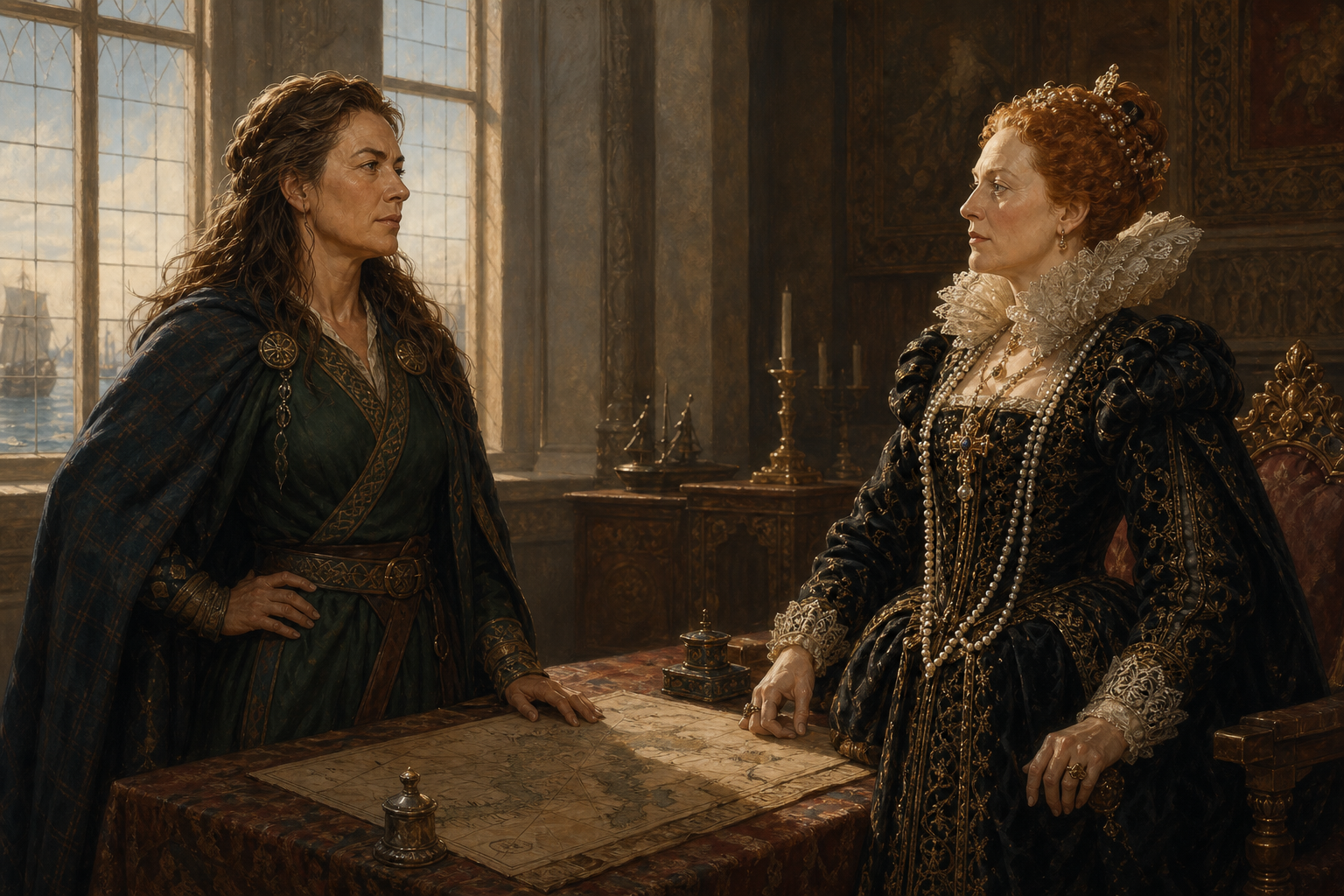
In 1593, Grace O’Malley met Queen Elizabeth I.
That sentence has carried a great deal of romance because it places two formidable women in one room at the edge of empire, gender, age, power, and performance. It is almost impossible not to stage it in the mind: the Irish maritime leader and the English queen, both older, both political survivors, both used to men underestimating what women in power could do.
The meeting came after Grace petitioned for the release of family members and sought relief from local English pressure. It was not a friendly tea between legends. It was negotiation. Grace needed something. Elizabeth’s government needed order. The meeting was extraordinary partly because it was practical.
Stories say they spoke in Latin, since Grace did not speak English and Elizabeth did not speak Irish. That detail, whether repeated with full confidence or some caution, has endured because it gives the scene dignity and strangeness. Two women from rival political worlds using a shared learned language to negotiate power: history could have chosen a duller image. It did not.
The outcome appears to have included promises and arrangements, though the longer political situation remained difficult. The meeting did not solve everything. Its importance is that Grace O’Malley had become significant enough to carry her case to the English queen herself.
That is not folklore. That is leverage.
Mother, Raider, Leader, Legend
Grace O’Malley’s legend often includes motherhood beside piracy, especially the story that she gave birth at sea and soon after helped defend her ship. It is a spectacular scene, almost suspiciously perfect in its symbolism: childbirth, battle, command, and the refusal to become fragile for anyone’s convenience.
Treat it as tradition unless verified in the specific form being told. But do not miss why it survives.
The story insists that Grace’s power did not require her to stop being a mother, and motherhood did not require her to stop being dangerous. That was the point later memory wanted to preserve. She made nonsense of the simple boxes.
Still, Her world was violent, hierarchical, clan-based, and politically harsh. Raiding had victims. Maritime power meant coercion as well as freedom. Grace O’Malley can be fascinating without being polished into innocence.
The contradiction must stand. She was a woman of authority in a world that did not expect women to be harmless. She was also part of a system where force was a normal instrument of politics.
What Grace O’Malley Reveals
Grace O’Malley makes the pirate label grow up.
She was not a Golden Age Caribbean captain, not a privateer in the neat English sense, and not a fantasy heroine floating outside law and politics. She was a Gaelic maritime leader whose life shows how ships, kinship, gender, local sovereignty, raiding, negotiation, and empire collided on Ireland’s western coast.
The famous meeting with Elizabeth I is the doorway. The fuller story is larger: a woman managing power before and after that scene, using the sea not as scenery but as a political instrument.
For another figure whose reputation depends on enemy perspective, read Francis Drake. For a Mediterranean comparison in female maritime power, continue to Sayyida al-Hurra. For the wider route, return to Famous Pirates.
Grace O’Malley did not need the English queen to make her important. The meeting survived because it made her importance visible to people who preferred their power written in English records.
The sea had known first.


