The story
The Queen Who Did Not Blink
Grace O’Malley did not need a skull flag to make a queen nervous.
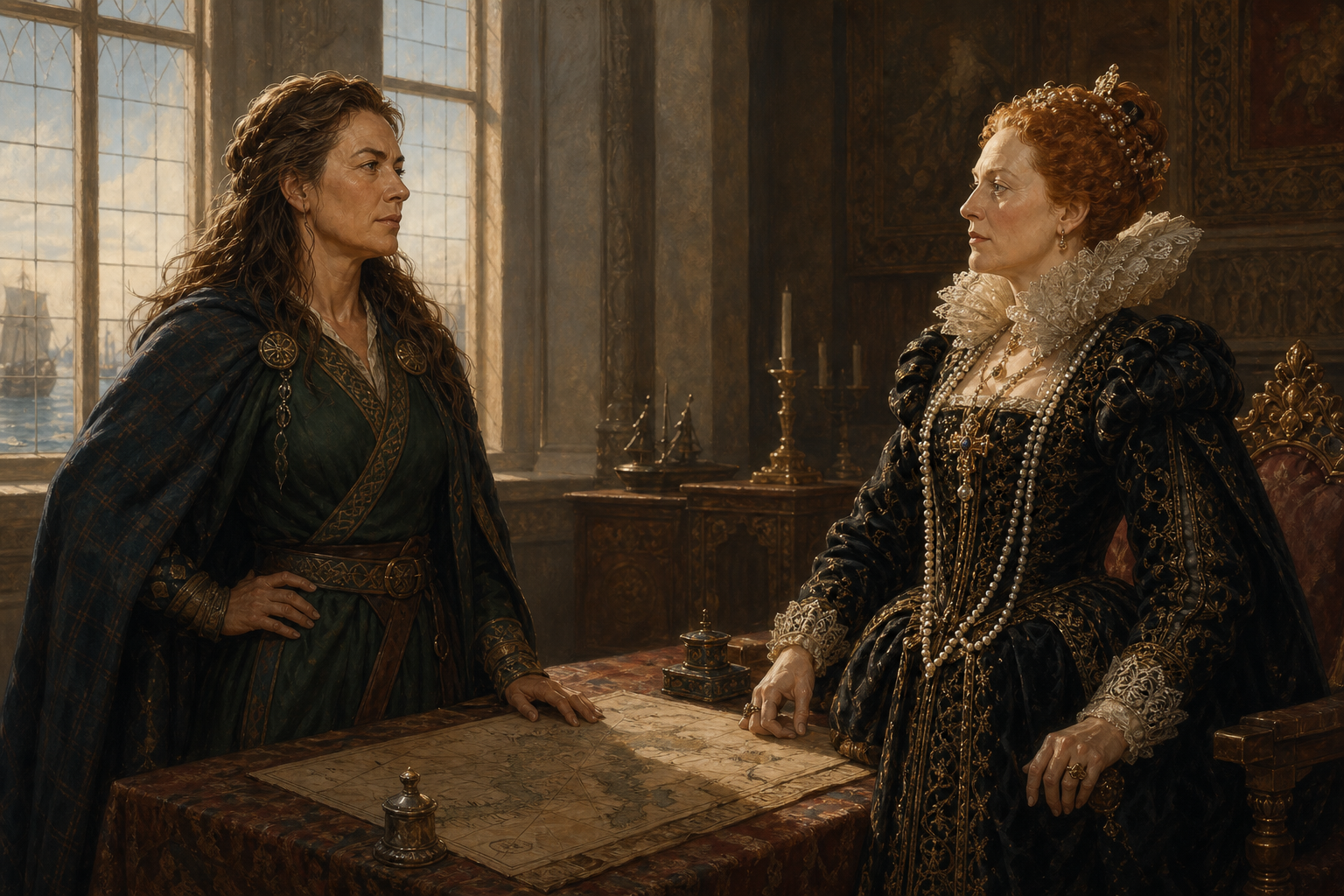
The meeting with Elizabeth I still works as a hook. It gives the story a scene almost too good to resist: an Irish sea lord and an English queen, two women with power in a world eager to explain power through men, facing one another while empire, family, ships, language, and survival pressed into the comparison. The famous scene is powerful. The history around it is bigger.
Grace O’Malley, or Gráinne Mhaol, belonged to the maritime politics of western Ireland in the sixteenth century. She was not a Caribbean pirate dropped into the wrong century. She was a Gaelic leader, a ship commander, a negotiator, a raider when conditions demanded it, and a woman whose power came from kinship, coastline, trade, and force. Calling her a pirate can help modern readers find the door. It cannot be allowed to lock the comparison.
A Coastline Was Her Power Base
O’Malley’s world was made of islands, inlets, castles, kin networks, local rivalries, English pressure, and Atlantic movement. Western Ireland was not a backdrop. It was the machinery of her authority. Ships gave mobility. Coastal strongholds gave shelter. Family alliances gave reach. Maritime skill turned geography into leverage.
The familiar version often turns her into a single defiant personality. She was certainly remembered as formidable, but personality alone does not hold territory, command ships, negotiate with officials, or survive repeated political shocks. Her power made sense because the coast made sense. A leader who understood that water could connect, hide, feed, enrich, and threaten people had more options than someone trapped on a road.
English authorities did not see her as charming folklore. They saw a local power whose activities complicated their efforts to control Ireland. The same actions could be described differently depending on who was writing: defense, raiding, piracy, resistance, lordship, disorder, or negotiation. The label often tells us as much about the speaker as it does about O’Malley.
The Meeting Became the Magnet
The meeting with Elizabeth I in 1593 became famous because it compresses everything.
Grace wanted practical outcomes. Her family and interests were under pressure. English authority was tightening. Petition, diplomacy, and personal presentation became tools. The scene survives because it gives later readers a dramatic shape: two queens, one island power facing a crowned monarch, no one politely disappearing into the wallpaper.
The problem is that a great scene can steal the whole life.
O’Malley was not important because she met Elizabeth. She was able to meet Elizabeth because she had already become important. The meeting was not a fairy-tale audience granted to an interesting rebel. It was a political encounter produced by decades of maritime power, local leadership, conflict, and negotiation. If the scene is treated only as attitude, it becomes smaller than the history behind it.
Pirate, Queen, or Problem?
The phrase “pirate queen” is memorable. It is also dangerous.
It can make O’Malley sound like a costume figure: dramatic, isolated, and slightly unreal. The cleaner reading keeps the drama but restores the system around her. She was a leader in a Gaelic maritime world under pressure from English expansion. She used ships and force. She negotiated when negotiation served her. She operated in a political culture where sea power, kinship, tribute, trade, and raiding were not easily separated into modern moral boxes.
Was she a pirate? To some English officials, that label made sense. To her own world, the answer was more complicated. She was more than an outlaw stealing for private amusement. She was a regional actor using maritime power in a contested political landscape. The tension is the point. O’Malley teaches readers that “pirate” is often an accusation before it is a biography.
It does not make violence disappear. Ships were taken. People were threatened. Power on the coast had costs. But it must also refuse the lazy version where a complex Irish leader is flattened into a Halloween title with a castle behind it.
Why She Still Holds the Room
Grace O’Malley endures because the story has everything memory likes: ships, defiance, family stakes, English pressure, local power, and a meeting with Elizabeth that feels built for retelling.
But the reason she matters is more than that she “did not blink.” It is that her life shows how maritime authority could survive inside a changing political world. She used the sea as route, shield, weapon, and bargaining position. She stood between Gaelic Ireland and English expansion without becoming a simple symbol for either side. That makes her more useful than the legend alone.
The best version keeps the meeting, but refuses to let it eat the whole woman.
For the main profile, see Grace O’Malley. For a wider route through women whose stories were made smaller by later retelling, see Women Pirates. Grace belongs there, but she also belongs in the history of power, coastlines, and the political uses of the sea.
The queenly part is memorable.
The not-blinking part is satisfying.
Grace O’Malley mattered because she had enough power behind her to make the meeting necessary.


