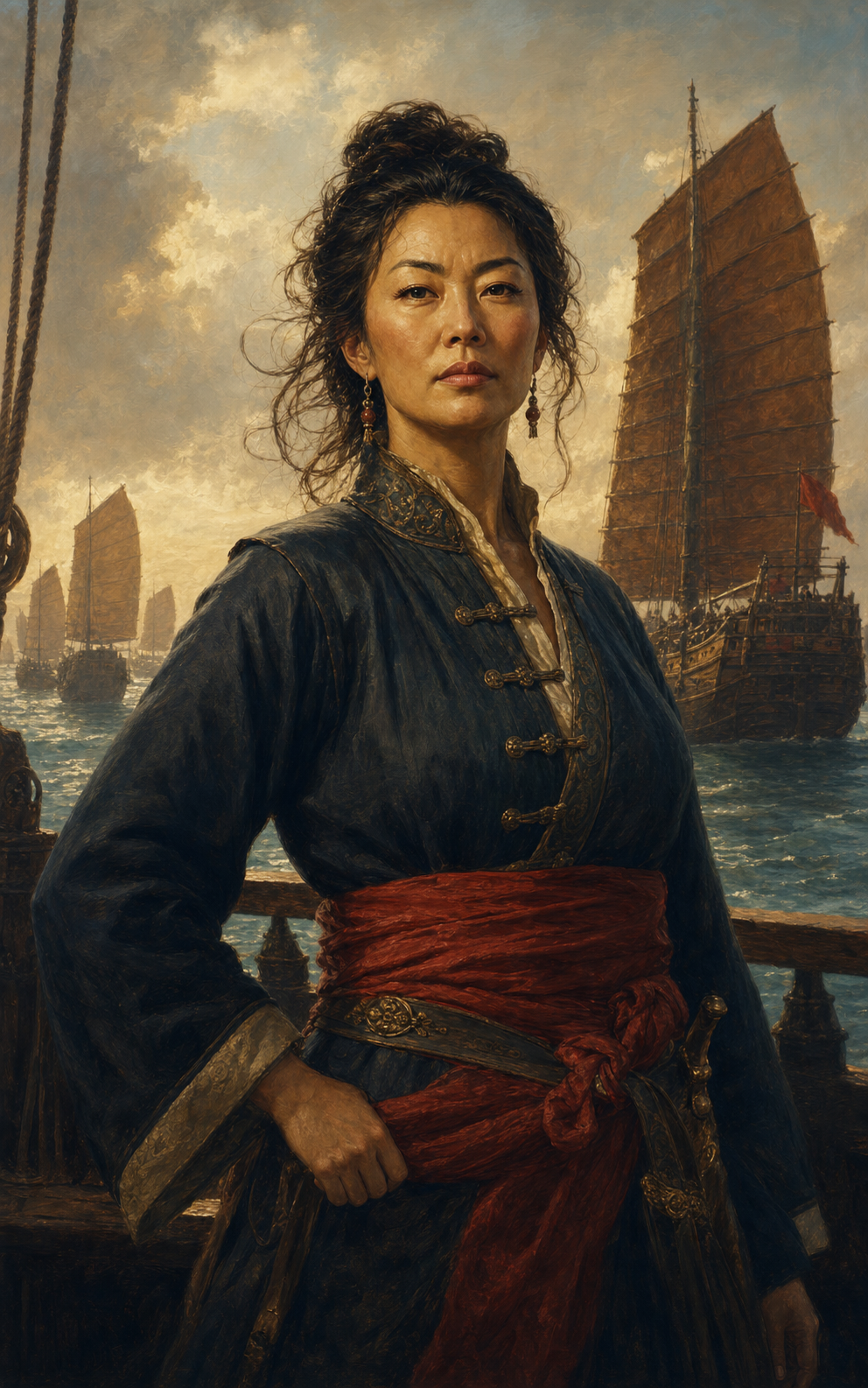
The story
Zheng Yi Sao Beat the Ending
Blackbeard became the pirate everyone recognizes first.
Zheng Yi Sao became something more dangerous: a commander whose power stretched across fleets, coastal communities, merchants, officials, and negotiations. The familiar pirate legend gives us one ship, one flag, one captain, and one violent end. Her career does not fit that frame.
Older English-language sources often call her Ching Shih. Zheng Yi Sao is a more precise name, meaning the wife or widow of Zheng Yi, the pirate leader whose South China Sea confederation became one of the largest pirate organizations in history. The names can confuse the trail. The scale should not.
Blackbeard had terror. Bartholomew Roberts had numbers. Zheng Yi Sao had organization, endurance, and an exit few famous pirates ever reached.
A Fleet, Not a Legend With a Sail
Zheng Yi died in 1807. In many pirate stories, that would be the beginning of collapse. A strong leader disappears, rival captains test one another, crews fracture, officials press harder, and the whole enterprise breaks into smaller pieces.
That did not happen here.
Zheng Yi Sao helped hold together a major confederation in the South China Sea, especially the Red Flag Fleet. Exact numbers vary across accounts, and the largest figures should be treated carefully, but the central point is secure: this was not a single raiding ship. It was a maritime organization large enough to force a state response.
That alone separates her from the usual pirate comparison game. Blackbeard’s fame rests on a short Atlantic career, a powerful image, Queen Anne’s Revenge, the Charleston blockade, North Carolina, and a bloody death at Ocracoke. Zheng Yi Sao’s power rested on command at scale.
A single pirate captain could frighten a merchant crew. A confederation could shape the choices of whole coastal communities.
Rules Kept the Fleet Together
A pirate fleet that large could not run on courage and appetite alone. It needed rules.
Accounts of the confederation describe discipline around plunder, desertion, captives, punishment, and internal conduct. Some details come through later sources and should be handled with caution, but the larger pattern makes practical sense. A fleet with many vessels, commanders, crews, and dependents needed order to survive.
That order did not make the confederation gentle. It made it harder to defeat.
Loot had to be divided. Captives had to be controlled. Disputes had to be contained before they broke the organization from inside. Crews had to believe that obedience paid better than defection. Shore contacts had to keep supplying food, repairs, information, and markets. Officials had to deal with a problem that kept returning.
This is where Zheng Yi Sao’s story becomes more than a headline about a “pirate queen.” Her authority was not just personal. It was administrative, political, and economic. She mattered because the organization around her worked.
The Shore Was Part of the Power
Pirates are easy to picture at sea and harder to understand on shore. Zheng Yi Sao’s world cannot be understood without the coast.
Fleets needed safe water, repairs, food, intelligence, buyers, families, informants, and communities that could be paid, threatened, protected, or drawn into the system. Fishing boats, merchants, local officials, coastal villages, and rival groups all became part of the pressure around the confederation.
The Qing state, Portuguese forces, and rival fleets all entered that struggle. Suppression was not a matter of catching one dramatic captain. It meant breaking a network of ships, money, people, and local relationships.
That is why the usual Blackbeard comparison falls short. Blackbeard became a perfect image of pirate fear. Zheng Yi Sao became a governing problem.
She Got Terms
Most famous pirates lose control of their endings.
Blackbeard was killed in battle. Bartholomew Roberts died off West Africa. Captain Kidd went to the gallows. Stede Bonnet begged, escaped, was recaptured, and hanged. Anne Bonny disappears into uncertainty after conviction. Henry Every vanished, and the silence became part of his legend.
Zheng Yi Sao’s ending is different. In 1810, many pirates connected to the South China Sea confederation accepted amnesty. She survived the settlement and, in later accounts, retained wealth and status.
That does not turn the violence into virtue. The confederation robbed, coerced, threatened, and damaged people. Survival with terms is not the same thing as innocence.
It is, however, extraordinary. Pirate history is full of men turned into warnings after the state caught them. Zheng Yi Sao helped force a settlement before that could happen to her.
Why the Comparison Matters
Blackbeard deserves his fame. He understood fear, used performance well, and left behind one of the strongest silhouettes in maritime history. His career was short, but his image was durable.
Zheng Yi Sao belongs in a different category. Her importance is not based on one terrifying look or one famous ship. It lies in scale, discipline, command continuity, coastal power, and negotiation.
If the question is which pirate became the most recognizable, Blackbeard is hard to beat.
If the question is who commanded the most serious pirate power and survived with terms, the answer points east.
For the fuller profile, continue to Zheng Yi Sao. For the wider route through women who commanded, fought, negotiated, or were turned into legend, follow Women Pirates.
Blackbeard kept the poster. Zheng Yi Sao kept the ending.


