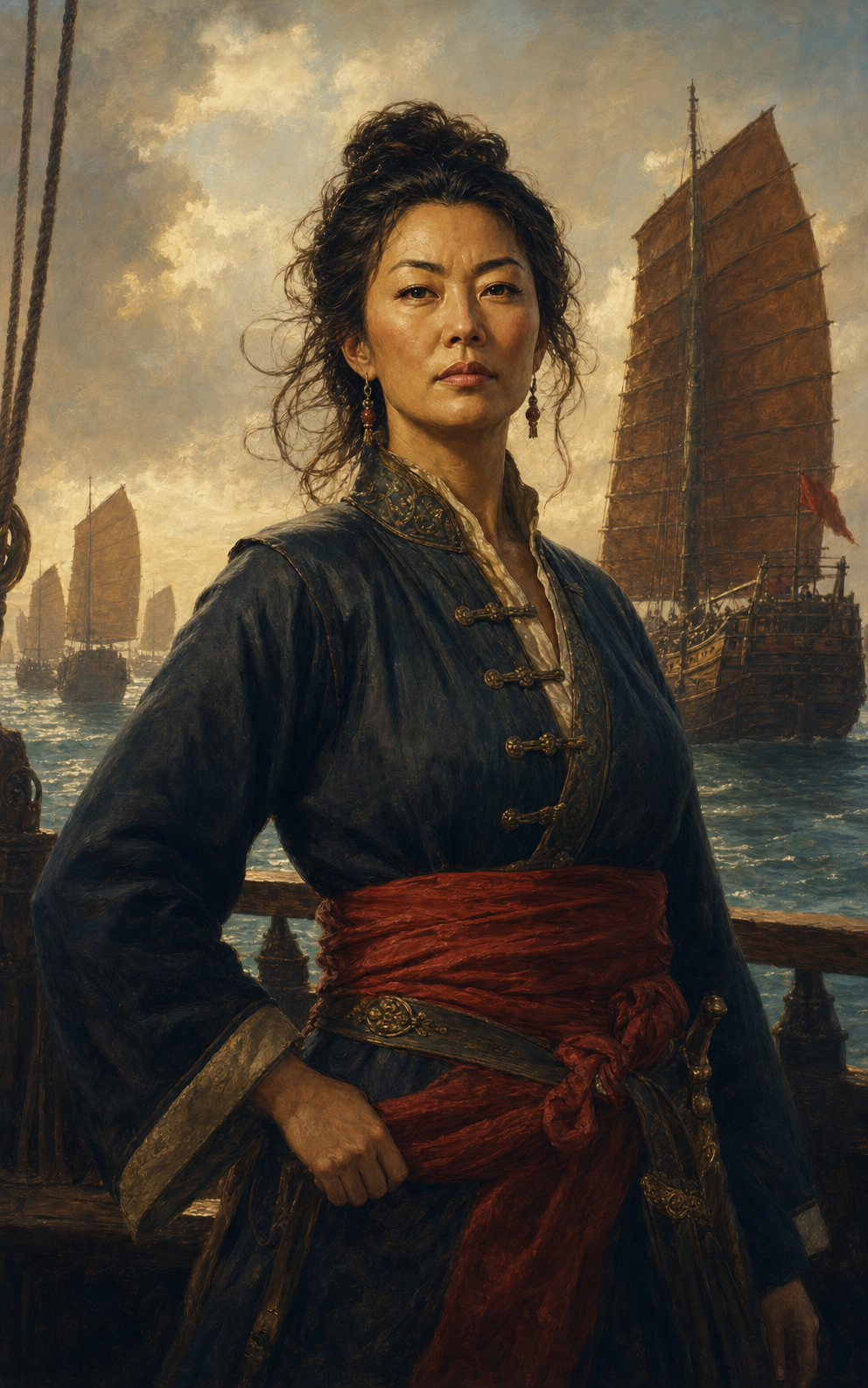
Negotiation is usually treated as the dull epilogue after the cannon smoke clears.
In Zheng Yi Sao’s story, negotiation is the point.
By 1810, the South China Sea pirate confederation associated with her and the Red Flag Fleet was too large, too organized, and too entangled with coastal life to be dismissed as a few criminals with fast boats. Officials could hunt pirates, but hunting a confederation is a different problem. It becomes military, economic, political, and embarrassing all at once.
That is when states begin to bargain, even if nobody enjoys the word.
The Phrase “Pirate Queen” Is Too Small
“Pirate queen” is catchy. It is also a little dangerous.
The phrase keeps Zheng Yi Sao visible, which is useful. But it can also turn a practical maritime commander into a symbol. Her power was more than personal nerve, and it was more than the miracle of a woman shouting louder than men. The evidence points toward organization: fleets, commanders, rules, punishment, distribution, shore relationships, and the careful management of violence.
A pirate crew can terrify for a week. A maritime confederation can make officials change strategy.
That difference is the heart of the story. Zheng Yi Sao’s significance does not rest only on gender, though her gender matters. It rests on command at scale. She was part of an organization that forced state response not because it was picturesque, but because it worked.
Gender Made the Story Memorable. Organization Made It Powerful.
Women in pirate history are often handled badly. They become exceptions, mascots, fantasies, or footnotes. Zheng Yi Sao can suffer from the opposite problem: she becomes so exceptional that the machinery around her disappears.
That is a mistake.
Her gender made her career astonishing in a world where maritime power is usually described through men. But the achievement was more than being a woman among pirates. The achievement was helping preserve authority in a large, dangerous, profit-hungry confederation after Zheng Yi’s death and helping convert that authority into terms.
That requires more than boldness. It requires alliances, incentives, discipline, and the ability to keep enough people obeying the system when betrayal might be profitable.
The story is more impressive when it stays practical.
The Confederation Was the Scary Part
Zheng Yi Sao’s power did not rest on one ship, one flag, or one theatrical captain. It depended on fleets, commanders, coastal communities, rules, revenue, and negotiations that made her a political problem, not a famous pirate name alone.
The South China Sea piracy crisis involved many vessels, coastal communities, commanders, markets, ransom, official pressure, rivals, family alliances, and rules. This was not one swaggering deck scene. It was maritime governance under outlaw conditions.
That is best unsettling. A disciplined pirate system can be more frightening than a chaotic one because it can repeat itself. It can collect, punish, bargain, and endure. It becomes part of the coastline’s political and economic weather.
Officials had to think beyond ordinary pursuit. Suppressing a ship is one thing. Unraveling a confederation is another.
Legend must not Replace Leverage
Zheng Yi Sao’s legend is large because the documented outline is large. It does not need invented speeches, impossible numbers, or a flawless statue version of her. Superlatives are strongest when they carry evidence rather than applause.
The safer claim is also the more useful one: she was among the most successful pirate leaders in history because her power combined scale, organization, discipline, command continuity, and negotiated survival.
That is enough.
If every retelling makes her unbeatable, the story becomes less human and less historical. She must remain extraordinary without being made supernatural. She was not magic. She was operating inside a violent maritime system and using that system with extraordinary effectiveness.
Why Empires Sat Down
States do not negotiate with pirates because pirates are charming. They negotiate when the alternative is costly, uncertain, or politically inconvenient.
The 1810 amnesty arrangements made sense because the confederation had become a durable problem. Surrender terms could break the system, divide interests, and transform continued resistance into a worse bargain. That was not softness. It was strategy.
Zheng Yi Sao’s story therefore belongs beside the usual gallows biographies because it shows another ending. Some pirates were crushed. Some vanished. Some were hanged in public to prove that the law still had reach.
She helped force a different answer.
How to Read Her
Read Zheng Yi Sao first as a commander inside a confederation, not as a decorative exception. Then read her as a woman whose authority exposes how narrow the usual pirate map has become. Then read the legend, because the legend explains why the story keeps traveling.
For the main factual route, return to Zheng Yi Sao. For the fate story, continue to Zheng Yi Sao Beat the Noose Because She Had Leverage. For a wider route through women pirates, follow Women Who Ruled the Waves.
The phrase “pirate queen” is too small for her. Zheng Yi Sao’s story is bigger than costume, bigger than exception, and bigger than the tidy pirate ending. She made a state calculate. That is the part history must not smooth down.
