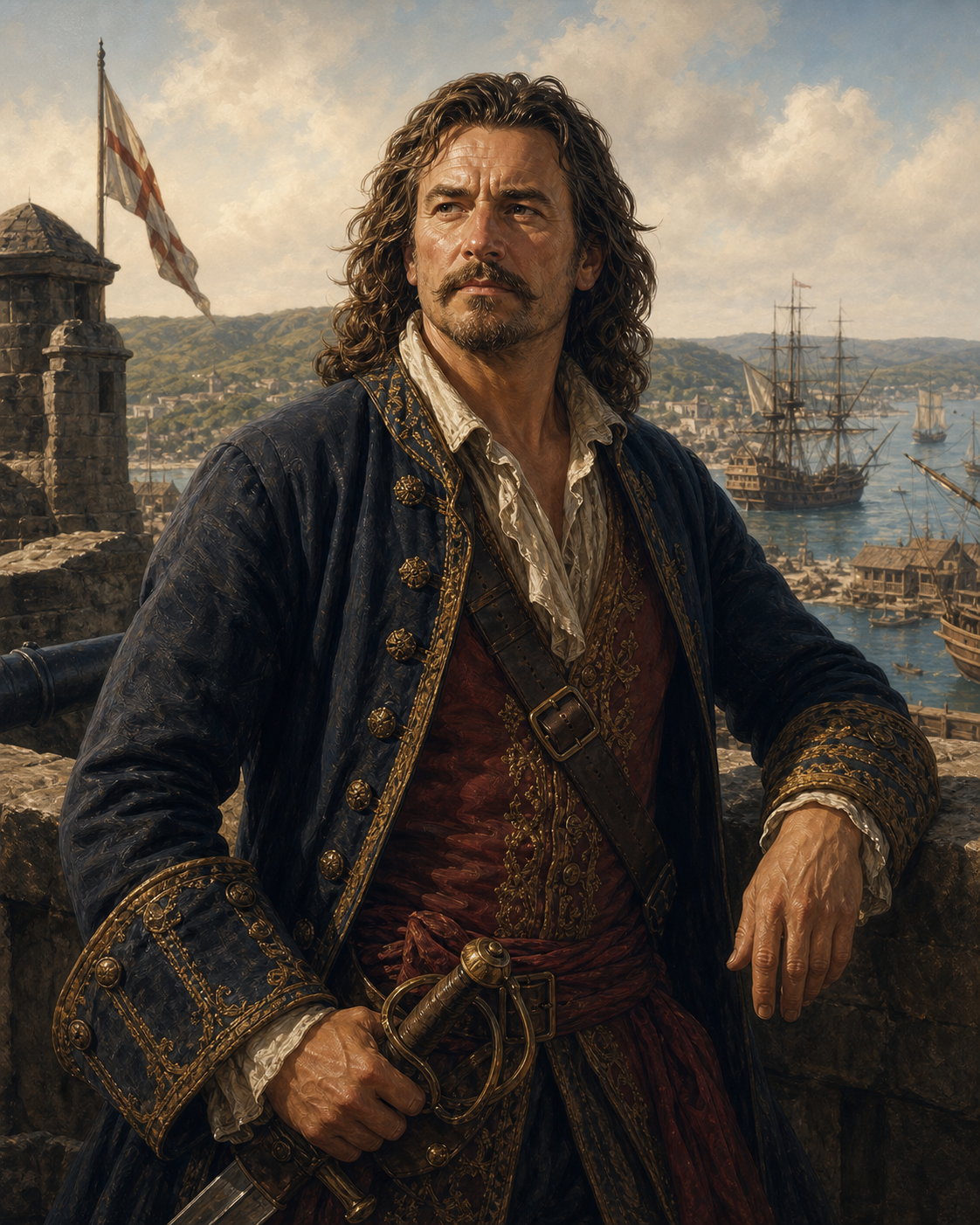
The story
The Cruelty Was Too Much
The movie pirate threatens beautifully.
He leans across a candlelit table, smiles with half his teeth, and lets the audience enjoy the danger without having to smell it. The blade is clean. The victim is frightened but presentable. The violence arrives with choreography and leaves before the comparison becomes impossible.
François l'Olonnais does not belong to that version.
He belongs to the uglier record of seventeenth-century buccaneering, where cruelty could become close, bodily, and difficult to turn into adventure. Alexandre Exquemelin's Buccaneers of America helped make l'Olonnais one of the most frightening names in Caribbean sea-roving: a French buccaneer whose hatred of Spaniards and appetite for terror became part of his historical afterlife.
The source must be handled carefully.
Careful does not mean comfortable.
The buccaneer world was already brutal
L'Olonnais operated in a Caribbean shaped by empire, war, privateering, slavery, smuggling, fortified towns, frontier violence, and the long contest over Spanish wealth. Buccaneers did not invent brutality in that world. They entered it, used it, and sometimes made it more profitable.
The seventeenth-century Caribbean was more than the earlier, rougher draft of the Golden Age pirate movie. It was a violent imperial workplace where law depended on flag, timing, patronage, and convenience. A raid praised by one side could be condemned by another. A commission could make violence useful until diplomacy changed its mind.
L'Olonnais came out of that harder buccaneer environment.
He is associated with attacks on Spanish ships and settlements, with raids that relied on speed, surprise, terror, and the extraction of information. That last word matters. In buccaneer stories, cruelty often appears as method rather than temper. Captives could be forced to reveal treasure, guide attackers, identify valuable people, or break resistance.
The horror was practical.
That makes it worse, not better.
Exquemelin gave him a terrible immortality
Exquemelin is essential and complicated.
His account preserves names, scenes, methods, and a vivid picture of buccaneer violence that would be poorer without him. It also writes with moral force, memory, translation history, commercial appeal, and a strong taste for the shocking detail. Readers wanted tales from the violent Caribbean. Exquemelin knew how to supply them.
L'Olonnais became one of the figures branded by that literature.
Some of the most infamous stories attached to him are so gruesome that they cannot be repeated casually or treated as entertainment. The exact details require source checking. The broader pattern is clear enough: l'Olonnais was remembered as a man whose violence crossed from ordinary raiding terror into enduring horror.
That is the historian's uncomfortable job here.
Do not pretend every lurid sentence is modern courtroom evidence.
Do not pretend the world was less savage because the source is difficult.
The safest profile keeps both truths visible: the record is mediated, and the reputation is monstrous.
Terror was part of the business
Buccaneer violence often had a purpose beyond the immediate wound.
Fear could make a town surrender, a captive speak, a ship strike colors, or a future enemy hesitate. A reputation for cruelty could travel ahead of a raiding party and do work that weapons had not yet begun. This was not unique to l'Olonnais. Terror was a language many violent maritime actors understood.
What makes l'Olonnais stand out is the intensity of the reputation.
He is not remembered mainly as a brilliant administrator, a daring navigator, a successful negotiator, or a man who later became inconveniently respectable. He is remembered as a nightmare in human form: the buccaneer who showed what the romantic pirate picture must hide to keep selling popular images.
It does not mean he was nothing but legend.
It means his legend is built around a real historical appetite for fear. The Caribbean rewarded men who could intimidate. L'Olonnais appears as one of the men who drove that logic into the dirt and kept digging.
The Spanish enemy and the revenge story
L'Olonnais is often presented as having a special hatred for Spaniards. That hatred may reflect experience, politics, propaganda, and the wider French and Spanish conflict in the Caribbean. It also gave later storytellers a clean engine for his cruelty: this man did terrible things because he hated this enemy beyond ordinary war.
Clean engines are suspicious.
Hatred did matter in the Caribbean. Religious conflict, imperial rivalry, privateering culture, colonial violence, and personal survival all sharpened enmities. But reducing l'Olonnais to pure revenge makes the system too simple. Buccaneering was more than personal fury. It was also money, opportunity, weak enforcement, alliances, markets, and violent labor.
Cruelty becomes easier to misunderstand when it is treated only as emotion. In the buccaneer world, cruelty could be emotional, strategic, performative, profitable, and retaliatory at once. That combination is why the case is so hard to clean.
The ending wanted poetic justice
Tradition gives l'Olonnais a violent end in Central America after his fortunes collapsed, often with details that feel like moral revenge arranged by an author who had grown tired of subtlety.
It does not make the ending false in its broad shape. It means the details need caution.
Stories about monstrous men attract endings that punish them correctly. The worse the villain, the more satisfying the reversal. L'Olonnais's reported death has often been told as a kind of brutal balance: the man who inflicted horror meets horror himself.
What can be said safely is enough. L'Olonnais did not retire into a mellow coastal inn with a collection of tasteful shells. His career belongs to a violent buccaneer world, and his memory belongs to the literature of fear that world produced.
Why l'Olonnais still matters
L’Olonnais prevents pirate history from becoming too comfortable.
The familiar pirate costume turns maritime crime into wit, boots, flags, and exciting weather. L'Olonnais drags the reader back toward captivity, torture, intimidation, colonial hatred, and the bodies that adventure stories often prefer to leave off the deck.
He also teaches source caution.
A famous horror story is not automatically clean evidence. A difficult source is not automatically fiction. Between those two mistakes sits the real work: identify the source, test the claim, explain the context, and let the reader see where documentation ends and later moral theater begins.
What Survives is not that every awful tale about l'Olonnais is best believed without question.
What Survives is that the movie pirate had to become prettier than this to survive as entertainment.
François l'Olonnais belongs to the part of pirate history that does not fit neatly on a party invitation. Good. The subject requires those pages too. Without them, piracy becomes a costume with the suffering removed, and history cannot be that convenient.


