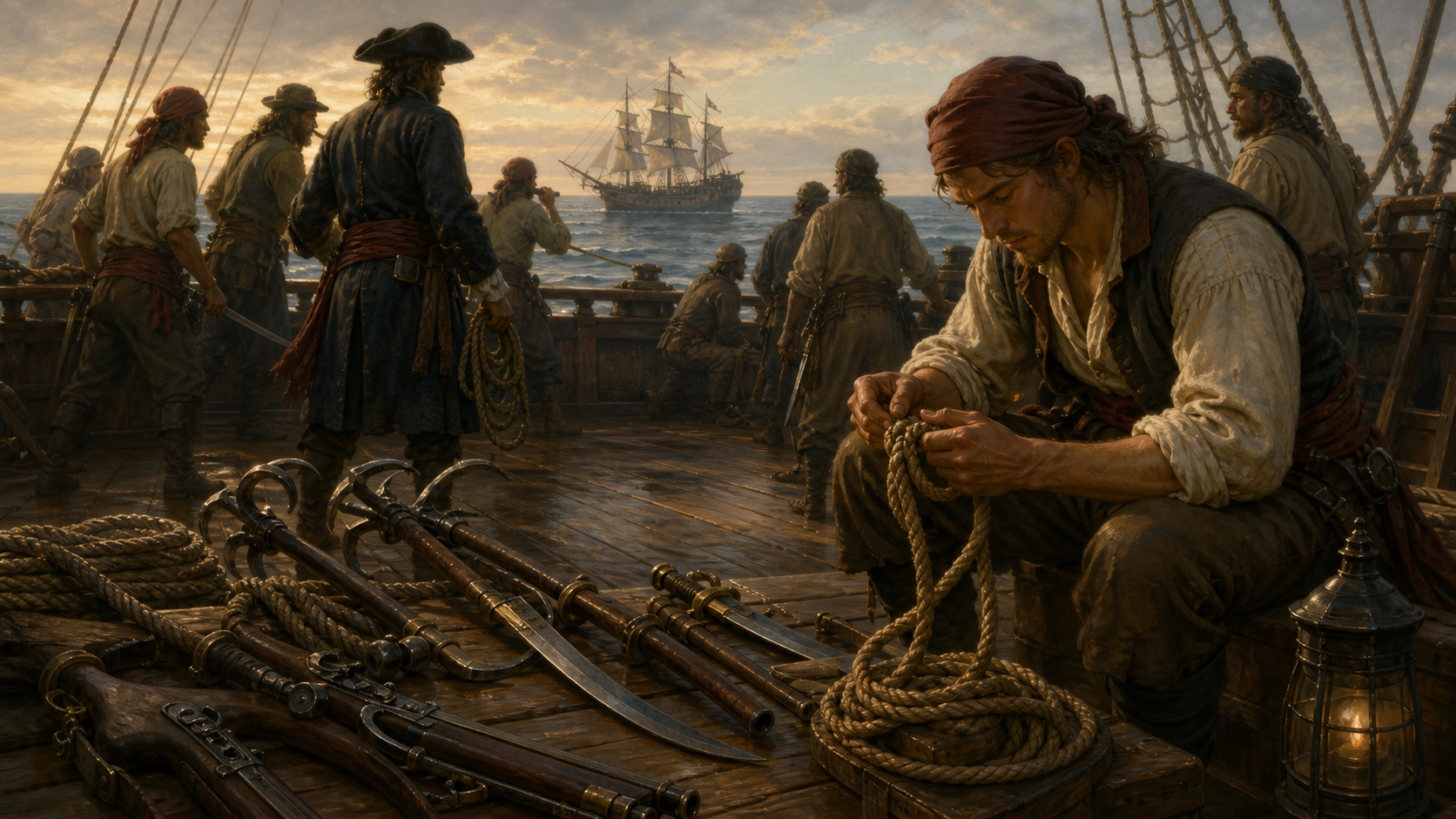
The story
The Pirate Pirates Feared
Edward Low became famous for a particular kind of piracy.
He became famous for making piracy look even worse. That took effort.
The Golden Age of piracy was already violent enough: captured ships, terrified crews, stolen cargo, beatings, hangings, threats, and men trying to turn the gaps in Atlantic law into money. Low's reputation still managed to stand out. Accounts of his career describe torture, mutilation, rage, and a cruelty that seemed less like a tool than a habit that had learned to walk upright.
Not every lurid story is best swallowed whole.
Pirate sources are often hostile, sensational, printed for appetite as much as accuracy, and eager to make villains useful to moral instruction. Low appears in that kind of record. The careful reader keeps one hand on the evidence and the other on the knife drawer.
But caution is not the same as rescue.
Even when the most theatrical details are handled carefully, the shape of Low's reputation remains ugly. He was remembered as a captain whose violence frightened enemies, disgusted observers, and made him dangerous even in a profession not known for warm manners.
The reputation arrives before the man
Edward Low was born in England and emerged into piracy during the early eighteenth century, when Atlantic seafaring was full of hard labor, brutal discipline, poor pay, war-trained sailors, and ships worth robbing. Many pirates came out of that world. They knew how merchant vessels worked, how captains commanded, how crews suffered, and how easily a ship could become a prison with sails.
Low's early life is not the central part of his afterlife. His reputation is.
He became associated with a series of Atlantic robberies and with a pattern of violence that later accounts found almost too memorable. A pirate captain could use fear to reduce resistance. If a merchant crew believed surrender meant survival, and resistance meant agony, fear did part of the work before weapons had to finish it.
That was the practical side of terror.
The darker question is whether Low crossed from practical intimidation into cruelty that damaged even his own usefulness. A captain who becomes famous for rage may frighten victims, but he also attracts hatred, pursuit, and the attention of every authority that wants an example with a neck attached.
Fear travels quickly. So does revulsion.
Cruelty could be a weapon
Pirates often preferred not to fight.
A battle could tear rigging, ruin cargo, kill skilled men, damage hulls, and leave a prize less valuable than it had been five minutes earlier. Terror could be cheaper. A reputation for savagery might make a merchant captain strike colors sooner, hand over papers faster, or reveal hidden money before the ship became a floating torture chamber.
It does not make the method clever in any admirable sense. It makes it worse.
Low's name became tied to precisely that ugliness: violence as communication. The threatened body became a message to the next crew. The mutilated prisoner became a rumor with legs. The captain's temper became part of the vessel's equipment.
The movie version of piracy tends to turn cruelty into a clean threat. A villain leans close, smiles, and the camera cuts away before the ugly part. Low's legend does not fit that shape. It belongs to a harder world where coercion could be intimate, bodily, and difficult to turn into family entertainment.
A parade of atrocities would only repeat the old problem in a new font. The surviving reputation is sharper than a list of horrors: cruelty was not incidental color. It was central to how Low was remembered.
Why even pirates had reason to worry
Pirate crews were not pure chaos.
They depended on fragile agreements: shares of plunder, watches, food, discipline, expectations, and enough internal trust to keep armed criminals from destroying one another before the navy had the courtesy to arrive. A captain could be fierce toward outsiders and still useful to his own men. That balance mattered.
Low's reputation makes the balance look unstable.
A captain known for explosive cruelty could become a danger inside the ship as well as outside it. Men followed pirate leaders because they expected profit, protection, and a workable order. If a captain's rage made decisions unpredictable, if his violence attracted too much pursuit, or if his cruelty threatened the crew's own survival, then terror stopped being an asset and became a leak below the evidence boundary.
Low is useful historically even when the details need checking. He shows the limit of pirate intimidation. Fear could make a crew powerful. Too much fear, or fear used stupidly, could make a captain radioactive.
Not every pirate wanted to sail with a man who made enemies everywhere and friends nowhere safe.
The source record
Much of what readers know about Low comes through accounts that were not neutral. Early printed pirate history loved criminals who could be turned into warnings. Newspapers liked shocking details. Officials had reasons to make pirates seem monstrous. Survivors had reasons to describe horror vividly and sometimes imprecisely.
So
First, Low was a real pirate captain active in the violent Atlantic world of the 1720s.
Second, his reputation for cruelty is persistent enough that it cannot be brushed aside as one stray exaggeration.
Third, individual anecdotes is best checked before they are allowed to carry the whole page.
That distinction does not make the story weaker. It makes it more frightening. The safer conclusion is not that every terrible scene happened exactly as printed. It is that Low became the kind of pirate whose name could carry those stories and still sound believable to the people who repeated them.
A reputation has its own evidence value, if handled carefully. It tells us what enemies feared, what readers expected, and what kind of violence later culture believed piracy could contain.
The uncertain ending
Low's final fate is not as clean as the gallows endings attached to many pirates.
Some accounts send him toward execution. Others leave him slipping into uncertainty. The lack of one firm public ending has helped the story remain unsettled. A hanging gives the state a final sentence. An uncertain disappearance leaves rumor in charge of the last paragraph, and rumor is a poor clerk but an enthusiastic novelist.
The uncertainty must stay visible.
A neat ending would make Low easier to file. The record is often less accommodating. It gives us a reputation, a trail of violence, hostile sources, possible exaggerations, frightened witnesses, and then a final shape that refuses to sit still.
That is enough to write the story honestly.
Low does not need a perfect final scene to matter. His afterlife was already built around the question of how far pirate terror could go before it became self-consuming.
Why Edward Low still matters
Edward Low cuts against the cheerful pirate costume.
He is not useful because he was the biggest pirate, the richest pirate, or the most strategically brilliant. He is useful because his reputation shows piracy at its most difficult to romanticize. He reminds readers that the black flag was more than a symbol on a mug. It could stand for coercion, mutilation, panic, and a human being realizing that the ship coming over the horizon was not interested in a fair adventure.
For comparison, Blackbeard shows how theatrical fear could become efficient branding. Bartholomew Roberts shows piracy organized at scale. Low shows the uglier edge: terror that may have worked, but also made the man carrying it seem poisonous.
That is What Survives.
Edward Low was not frightening because every story about him can be trusted equally. He was frightening because his reputation remained terrible even after caution entered the comparison.
Pirate legend often makes villains charming with enough time.
Low resists the polish. Good. Some names must still leave splinters.


