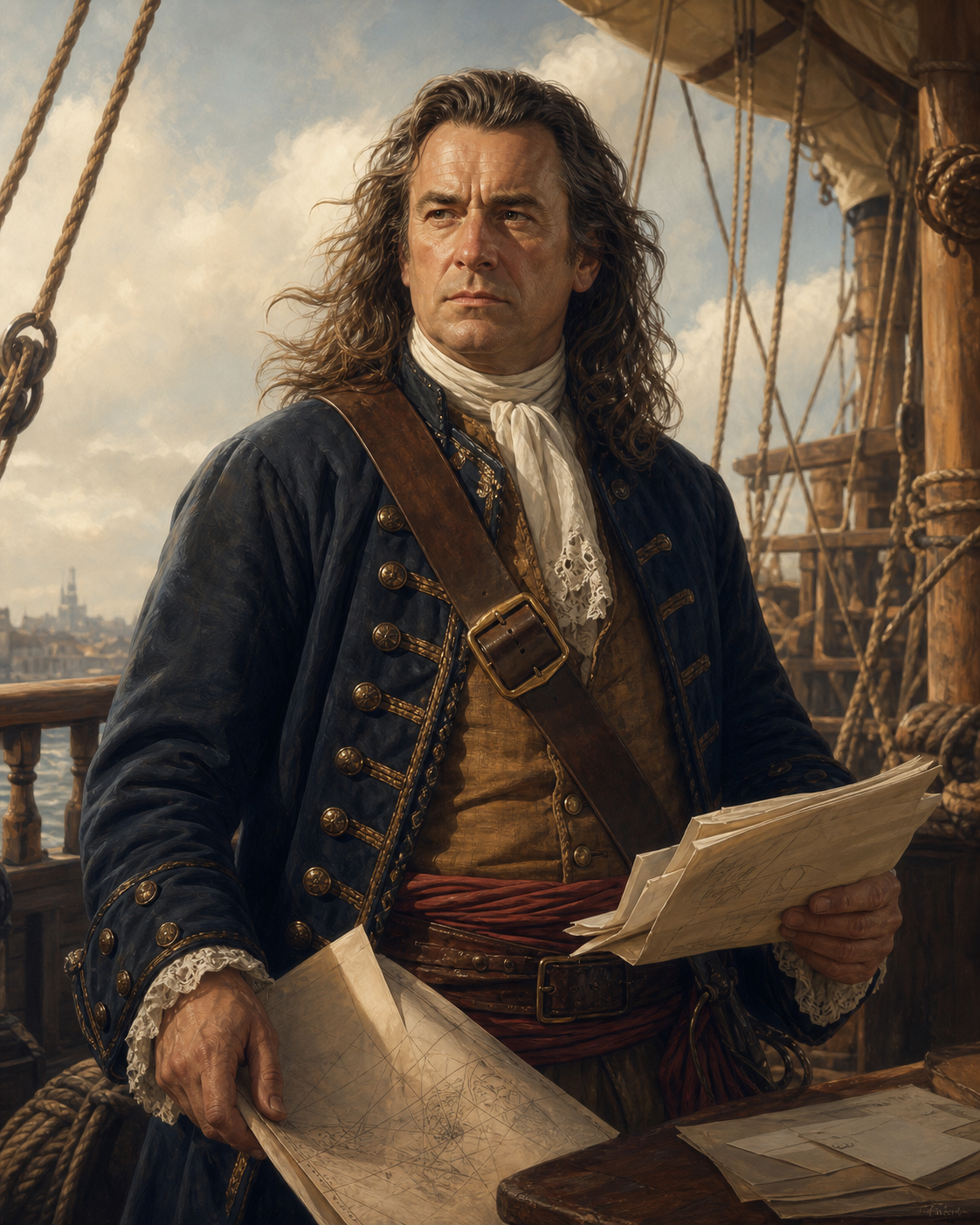
The story
Captain Kidd’s Trial Smelled Wrong
Captain Kidd is remembered through treasure rumors. The trial is the sharper object.
William Kidd sailed with commissions, investors, political expectations, disputed prizes, angry merchants, and powerful sponsors who later had reasons to step backward. His case sits near the unstable border between privateering and piracy, where paperwork could look solid in port and suddenly feel thin after the wrong ship was taken or the wrong people complained.
The noose did more than punish one captain. It helped powerful men explain a voyage that had become embarrassing. Kidd was useful while he could be described as a privateer hunting pirates and enemy shipping. Once the voyage became a liability, isolation became convenient.
The Commission And The Trap
Kidd was born in Scotland and made his career in the Atlantic maritime world, where privateering could be respectable violence if it followed the rules. A privateer was not a pirate with better stationery. He needed authorization, targets that could be legally taken, and a prize process that converted capture into recognized profit. That system was full of temptation. The sea was wide, information traveled slowly, and the difference between enemy cargo, neutral cargo, protected cargo, and politically inconvenient cargo could become dangerous after the fact.
Kidd's voyage began with backing from influential men and a mission to hunt pirates and enemy prizes. That framework is essential. Without it, his story collapses into the ordinary tale of a rogue captain. With it, the case becomes sharper. Kidd was supposed to be part of the solution to piracy and illegal commerce. Instead, he came home as the problem. His sponsors had to decide whether he was a misunderstood servant, an embarrassment, or a convenient example.
The capture of the Quedagh Merchant became central to the case because it exposed the danger in Kidd's legal position. The vessel had connections and paperwork that made the seizure hard to defend cleanly. Kidd may have believed he had grounds to take it, or he may have been stretching the rules because his expedition needed success. The surviving story is full of argument because the law itself was full of pressure. Privateering rewarded aggression, but only if the paperwork, politics, and timing held together afterward.
The sponsors matter because they show how respectable people could benefit from violent maritime ventures while keeping the language clean. A commission turned risk into policy. Investors could imagine prize money, imperial service, and the suppression of piracy in the same breath. Kidd's later danger was that the same network which made his voyage possible could not protect him once the voyage became politically poisonous. Privateering often depended on people ashore agreeing that the violence had been useful and lawful.
The Quedagh Merchant also helps explain why Kidd's story traveled so far. It connected a single captain's decision to Armenian merchants, Indian Ocean trade, English politics, and the credibility of the men who had backed him. A disputed prize could become a diplomatic embarrassment, and embarrassment is often what turns a messy case into a public sacrifice. Kidd's fate was shaped by what he did at sea, but also by what powerful people needed his story to mean once he came home.
Why Politics Closed In
Kidd returned to a world less forgiving than the one that had sent him out. Complaints had weight. Political enemies had opportunities. Sponsors who once saw profit or public service in Kidd's mission now saw risk. That does not automatically make Kidd innocent, and it does not turn him into a pure victim. It makes the case worth reading carefully. His career shows how quickly sanctioned violence could become criminal violence when the powerful people around it needed distance.
The trial in London gave the public a cleaner story than the voyage itself. Trials are built to produce verdicts, not to preserve every uncertainty. Kidd faced charges of piracy and murder, including the killing of a crewman, William Moore. The courtroom reduced a wide maritime tangle into evidence, testimony, legal argument, and a sentence. That was necessary for the law, but it was not the same as a complete biography.
The trial did not need to make the voyage simple in order to punish Kidd, but public memory simplified it afterward. The courtroom turned arguments over authority, motive, crew pressure, prize legality, and political patronage into a verdict people could repeat. Treasure legend then simplified it again, replacing the legal machinery with a hidden object.
Execution Dock gave the story its public ending. Kidd was hanged in 1701, and his body was displayed as a warning. That display was part of the message. Piracy was more than punished in private; it was staged as a lesson for sailors, merchants, and anyone tempted to turn authorization into plunder. The state wanted the body to say what documents and speeches could not say as efficiently: here, the line ends.
There was also pressure from below. A captain at sea had to answer to papers in London and to a crew expecting reward. Long voyages without profitable captures could sour discipline. Men who had signed on for danger and prize money might not remain patient while legal distinctions were debated over the horizon. That does not excuse a bad capture, but it helps explain why the gap between commission and piracy could become wider with every hungry week at sea.
The Treasure Rumor
Treasure made Kidd easier to remember and harder to understand. He did bury some goods on Gardiners Island before his arrest, and that real cache helped later rumor grow teeth. But one documented deposit is not the same as endless secret maps, ghost ships, and convenient beaches waiting for moonlight. The known treasure belongs to the legal case. The later treasure mythology belongs to culture's appetite for a cleaner object than disputed commissions and prize law.
A buried chest is simple. Politics squirms. A chest can be imagined, hunted, drawn on a map, and promised to children, tourists, novelists, and treasure seekers. The legal story asks readers to follow investors, commissions, maritime courts, imperial rivalry, Armenian merchants, English politics, and the awkward fact that empire often depended on controlled violence until that violence became embarrassing. It is not surprising that folklore preferred the chest. The chest sits still. The politics wriggle.
The treasure tradition should not be mocked out of existence. It should be put in its proper place. Kidd's treasure rumors survived because the historical case had everything a legend needed: an executed captain, a disputed moral identity, a real hidden cache, missing wealth, famous names, and an ending that refused to stay settled. Readers who want the broader myth correction can continue to treasure maps and pirate money. Kidd is one of the reasons that myth never quite dies.
Gardiners Island gave later legend one hard seed of truth. Kidd really did place valuables there, and the cache was recovered. That fact matters precisely because it is limited. It anchors the story without proving every later rumor. A real deposit can become a myth factory when the executed man is famous, the money is partly accounted for, and readers want the world to contain one more hidden chest. The evidence supports a specific episode, not an unlimited invitation to invent maps.
Privateer, Pirate, Or Scapegoat?
The honest answer is not a slogan. Kidd was a commissioned captain whose actions led to a piracy conviction. He was also a man caught in a world where maritime violence, private profit, and state power overlapped. Calling him simply a pirate misses the machinery that sent him out. Calling him simply innocent ignores the victims, the disputed captures, the killing aboard ship, and the legal judgment that ended his life. The harder truth is that Kidd shows how privateering could become a trap for every party involved: captain, crew, sponsors, merchants, and government. He does not need ghost ships or breathless treasure chatter to be interesting. The true case already has everything: ambition, law, pressure, money, reputation, political abandonment, and a public execution. If the body of the story stays calm, the facts create the pull. Kidd's story is dramatic because the facts create pressure on their own.
It is also a reminder that pirate history must not treat victims as scenery. Captured vessels involved crews, owners, merchants, families, investors, and trading communities. A disputed prize was more than a plot point for the captain. It could mean lost cargo, diplomatic complaint, legal retaliation, and real danger for people caught in the seizure. Kidd's reputation has often been argued through his innocence or guilt, but the wider story includes everyone pulled into the consequences of his voyage.
Execution Dock was chosen for meaning as much as convenience. Mariners, merchants, and London crowds understood the message: crimes at sea could be answered by power on shore. Displaying Kidd's body afterward extended the warning beyond the moment of death. It made his punishment part of the river landscape, a grim advertisement for the reach of the law. The spectacle helped turn a complicated legal case into a public lesson that could be remembered even by people who did not understand the commission.
The legal story is stronger than the buried-treasure version. Kidd forces the reader to watch legality being made, tested, and withdrawn. He shows how maritime violence could be hired, praised, condemned, and punished by people who were not necessarily eager to admit their own part in it. The drama is colder than a map and more honest about the people who profited from maritime violence.
What Kidd Reveals
Kidd remains famous because he offers several stories at once. To treasure hunters, he is the man who might have hidden more. To legal historians, he is a warning about privateering, prize law, and political convenience. To pirate legend, he is the captain whose death did not end the hunt. To readers trying to understand piracy, he is a case study in labels. Pirate, privateer, criminal, scapegoat, and imperial servant can overlap in the same life without meaning the same thing.
For the wider legal background, follow piracy law and letters of marque. For the broader gallery of lives shaped by reputation and punishment, return to Famous Pirates. Kidd belongs in both places. He is more than a man at the gallows or a rumor under sand. He is a reminder that piracy often becomes most revealing when it forces us to ask who authorized violence, who profited from it, who paid for it, and who was left holding the blame when the story became too expensive.


