Article
The legend, tested
The map with a neat X is one of piracy's most durable inventions.
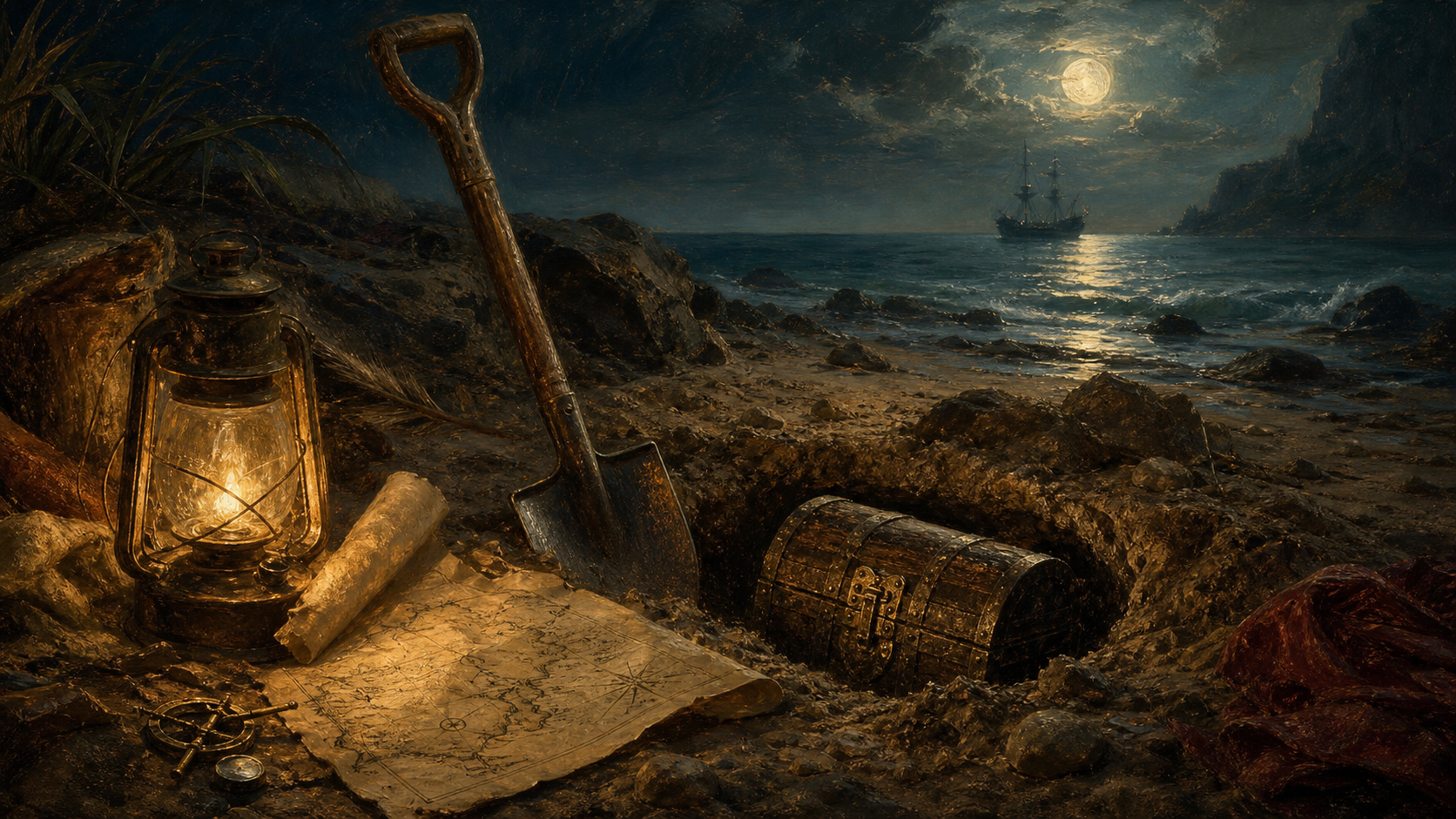
The treasure map is one of piracy's most successful inventions, which is awkward because pirates themselves were usually not the inventors. The familiar version gives us stained parchment, a dotted line, a skull, an island, and an X that promises greed can be solved with a shovel. It is excellent fiction. As a default account of pirate money, it is much weaker. Pirates certainly stole wealth. They also used charts, coastal knowledge, anchorages, pilots, rumors, and memory. What the evidence does not support as a normal pirate habit is the tidy theatrical map to a buried chest.
It does not make the myth useless. It makes it revealing. Treasure maps show how later culture turned maritime crime into a puzzle. The real work of piracy involved ships, cargo, crews, markets, courts, ports, fences, suppliers, taverns, officials, and risk. The map myth removes most of that machinery and gives the reader a clean game: find the mark, dig the hole, win the story. The true route is less tidy, but it is more interesting because it follows how stolen value actually moved.
Pirate Money Wanted To Move
A captured ship could carry coin, cloth, sugar, tobacco, weapons, tools, food, wine, spices, metal, medicine, enslaved people, paperwork, and other goods that had value because somebody could use or sell them. A pirate crew usually needed plunder to become shares, supplies, repairs, protection, drink, clothes, bribes, or escape. Wealth sitting underground did none of those things. It had to be guarded, remembered, recovered, and trusted to remain where the crew left it. That is a lot of confidence to place in sand, secrecy, and human nature.
Some hiding certainly makes sense. A person being pursued might conceal valuables temporarily. A crew short on storage might leave something ashore. A sailor might know a place where goods could be cached until the danger passed. But a temporary cache is not the same thing as the classic treasure map. The classic map implies a stable secret, a planned return, and a clue system designed almost politely for future adventurers. Pirates were often suspicious, practical, and opportunistic. Their stolen goods were usually more useful in motion than in a hole.
The money trail points toward networks, not riddles. Goods had to reach buyers or be converted into something a crew could spend. That meant ports, merchants, sympathetic officials, corrupt officials, ship suppliers, and communities willing to look away when profit was available. Pirate strongholds and friendly harbors mattered because stolen wealth requires a place to become useful. For that side of the story, see Pirate Strongholds and Hideouts. The historical map of treasure was often a network of routes, contacts, weak enforcement, and practical geography.
That network also explains why buried treasure is usually the least efficient answer. Coin could pay wages, bribes, and bills. Cargo could be broken up, disguised, traded, or moved through middlemen. Ship stores could keep a crew alive. Weapons could be kept or sold. Information could be valuable too: papers from a captured vessel might reveal owners, ports, cargo, insurance, or political risk. A chest under a tree is dramatic, but a useful buyer at the right harbor is better business.
Charts Are Not Treasure Theater
Part of the confusion comes from mixing up different kinds of paper and knowledge. Mariners used charts, rutters, bearings, soundings, coastal memory, pilots, and local information to survive dangerous water. Pirates cared deeply about reefs, channels, currents, shoals, anchorages, ports, hiding places, and escape routes. A rough sketch of a coast or anchorage could be useful. So could captured ship papers that revealed a vessel's route, cargo, ownership, nationality, or legal risk.
That practical paperwork is not the same as a decorative map to buried treasure. The first helps a ship move. The second helps a story sparkle. A pirate crew might preserve information about where to find water, how to enter a harbor, where a patrol was weak, or which coast offered shelter. That is navigation and intelligence. It belongs to the hard business of staying alive and making robbery profitable. The dotted line to a chest belongs mainly to adventure culture.
Wrecks and court records are more useful evidence than romantic maps. The Whydah, for example, gives historians material objects rather than just a legend about wealth. Trials, depositions, inventories, and official records show how stolen goods were described when law caught up. For that material route, read the Whydah wreck. The lesson is not that treasure was imaginary. It is that evidence usually arrives as objects, testimony, papers, and legal aftermath, not as a puzzle drawn for a child with a spade.
There is a second lesson in those records: pirate wealth was social. It passed through hands. Someone hauled it, valued it, divided it, concealed it, bought it, laundered it, complained about it, or testified about it. That creates traces. A map to a secret chest hides the social trail and makes treasure feel isolated from people. The record usually does the opposite. It pulls victims, crews, merchants, officials, and courts back into the same story.
Why The Map Won
Adventure fiction made treasure maps feel inevitable because they are nearly perfect plot machines. A map gives the story an object everyone can want. It turns landscape into sequence. It lets the dead pirate remain active as the vanished author of the adventure. It gives the reader a role: hunter, solver, discoverer. That is a cleaner structure than the historical economy of piracy, which sprawls through stolen cargo, nervous merchants, bribed officials, unpaid victims, and courts trying to make sense of violence after the fact.
The map also changes the moral atmosphere. Stolen property becomes destiny. The island becomes a board. The buried chest becomes a prize waiting for the clever rather than the proceeds of robbery. The image is so durable. It removes victims, labor, paperwork, fear, and market networks, then replaces them with a riddle. The map is fun, memorable, and historically thin. It is also a reminder that pirate mythology often works by simplifying the unpleasant parts until they fit on a symbol.
The treasure map is a brilliant symbol because it makes greed visible and adventure navigable. The historical correction is that pirates more often needed buyers, supplies, secrecy, speed, safe water, and enough luck to avoid capture. They did not usually need decorative cartography with an X helpfully marking the evidence.
The map lied in the sense that the famous image teaches the wrong habit: it asks readers to imagine pirate wealth as a hidden object rather than a moving system. Pirate money did not lie. It left traces in ships, goods, wrecks, legal cases, port economies, and the repeated need to turn stolen value into something spendable.
The Real Treasure Hunt
The honest answer is inconvenient in the best way. Pirates used knowledge of places, routes, papers, ports, and people. They could hide valuables when circumstances demanded it. They certainly cared about where things were. But the famous parchment map to a buried chest is mostly the gift of later adventure storytelling. Keep it for games, costumes, and novels. For history, follow the money through ships, ports, buyers, wrecks, trials, and rumor.
That route gives readers a better treasure hunt. It asks what was stolen, who could sell it, who protected the transaction, who suffered the loss, and how the story changed once fiction got hold of it. For the wider buried-treasure tradition, continue to Pirate Buried Treasure, or return to Pirate Legends and Myths. The X marks the spot because fiction loves a clean destination. History usually gives us a messier route, and in this case the mess is where the historical treasure is.
<!-- Codex notes: - Import as draft only. Do not publish automatically. - Preserve attribution decision exactly as specified in frontmatter. - Review internal links against current Umbraco paths before publishing. - Source queue bucket: Blank-author, requires attribution decision - Audit note: Review for small clarity, evidence, and ending improvements without stretching the topic. -->


